Build workforce awareness. Strengthen organisational preparedness.

Protective security is everyone’s responsibility.

The strongest protective security strategies adopt a layered approach in line with the key requirements of the Terrorism (Protection of Premises) Act 2025 (also known as Martyn’s Law). While those responsible for protective security require advanced capability, effective preparedness begins with an informed workforce.

The Level 2 CTPSA qualification developed by SFJ Awards helps organisations build this essential awareness, supporting staff working in, or supporting, venues, sites and organisations to become informed contributors to organisational preparedness and resilience. It supports staff to play an effective “internal champion” role by providing timely observations and information to the responsible person and/or colleagues with more formal counter-terrorism and protective security responsibilities.

SFJ Awards approved centre logo

Who should attend?

The Level 2 Award equips frontline staff and those working in public-facing environments with the knowledge and awareness to maintain vigilance, report concerns appropriately, and understand the immediate actions to take in response to a potential threat.

It is suitable for a wide range of roles, including:

Large audience watching live performance in dimly lit venue, backs of heads visible
  • Customer-facing staff
  • Reception and front-of-house teams
  • Security personnel, event staff and stewards
  • Facilities and estates teams
  • Supervisors and team leaders
  • Volunteers and contractors
  • Local authority staff
  • Healthcare staff
  • Retail, hospitality and visitor economy employees

For staff with specific responsibility for their organisation’s protective security, the SFJ Awards Level 3 Award in Counter-Terrorism Protective Security and Preparedness (CTPSaP) – the only qualification of its kind developed in partnership with National Counter-Terrorism Security Office (NaCTSO) and endorsed by Counter-Terrorism Policing (CTP) – provides advanced capability.

Why choose Skills for Justice Training?

As the UK Sector Skills Council for justice, and part of The Workforce Development Trust group:

• We have a unique understanding of the intent and expectations behind the national standard

• We have access to the sector expertise that underpins this qualification

• We work in collaboration with Skills for Health and People 1st International to support organisations across health, justice, retail, transport, tourism, hospitality and protective services

What truly sets Skills for Justice Training apart is the calibre of the practitioners delivering both the Level 2 and Level 3 protective security qualifications.

Our expert trainers have spent decades protecting people, places and public spaces, enabling them to bring real operational experience into the classroom through practical examples, discussion and scenario-based learning.

Their backgrounds span counter-terrorism policing, protective security, intelligence, major event security and crisis response.

What learners will gain

Following the one-day course, learners will understand:

  • The current terrorism threat context
  • Common terrorist attack methodologies
  • Suspicious behaviour and suspicious items
  • Maintaining vigilance in public-facing environments
  • The importance of reporting and escalating concerns promptly
  • Immediate response actions
  • The purpose and key requirements of the Terrorism (Protection of Premises) Act 2025 (Martyn’s Law) at an awareness level
  • Public access trauma first aid awareness.
  • Their role in supporting organisational preparedness.
Adult male student in classroom environment

Course overview

This is a tutor-led course comprising one day of online or face-to-face training.

Total qualification time: 7 hours. Guided learning: 7 hours.

View the full SFJ Awards Level 2 CTPSA qualification specification.

Core content

To be awarded this qualification the learner must achieve 1 mandatory unit in Counter-Terrorism Protective Security Awareness.

Assessment is through a 25-question multiple-choice test set by SFJ Awards, providing organisations with evidence that learners have successfully demonstrated their understanding.

Pricing and booking options

As a not-for-profit organisation, our pricing is transparent and inclusive – what you see is what you pay, with no additional fees.

Online classroom: £199 per learner

For group and organisational bookings, online delivery can be structured to reflect your operating environment, workforce roles and existing procedures – supporting consistent understanding across teams responsible for safety, security and incident response.

We are currently accepting booking requests via [email protected]. Training dates will be available to book online shortly.

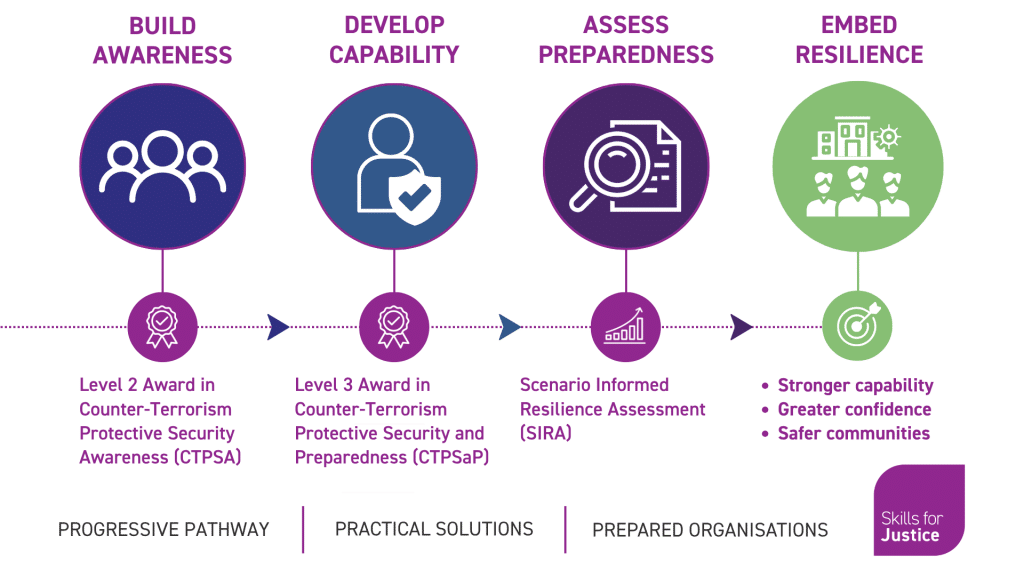
Skills for Justice resilience learning journey

Part of a wider protective security journey

The Level 2 Award provides the essential awareness needed by staff working in public-facing environments, enabling frontline teams to recognise, report and share information that supports effective protective security and preparedness.

For those responsible for assessing risk and leading protective security, we also deliver the separate SFJ Awards Level 3 Award in Counter-Terrorism Protective Security and Preparedness (CTPSaP), developed in partnership with NaCTSO.

Beyond qualifications, our Scenario Informed Resilience Assessment (SIRA) helps organisations stress test preparedness using evidence-based scenarios.

Together, these solutions support a progressive journey from workforce awareness and protective security capability to stronger organisational resilience.

Frequently asked questions about the Level 2 Award in Counter-Terrorism Protective Security Awareness

Who is this course suitable for?

The Level 2 Award is designed for frontline staff and those working in public-facing environments. It is suitable for anyone whose role may involve recognising suspicious behaviour, identifying potential threats, responding appropriately to an incident or supporting protective security within their organisation.

The qualification is relevant across a wide range of sectors, including local government, healthcare, retail, hospitality, events, leisure, transport, education and the wider public sector.

No. There are no formal entry requirements for the qualification, and no prior knowledge of protective security or counter-terrorism is required.

However, centres must ensure that learners are able to complete this qualification, for example, through completing a skills scan to ensure they can work at the appropriate level.

The qualification is assessed through a 25-question multiple-choice examination at the end of the course.

Learners who successfully achieve the required pass mark will be awarded the SFJ Awards Level 2 Award in Counter-Terrorism Protective Security Awareness (CTPSA).

The two qualifications have different purposes and are designed for different roles within an organisation.

The Level 2 Award in Counter-Terrorism Protective Security Awareness (CTPSA) provides the foundation, equipping frontline staff and those working in public-facing environments with the awareness to recognise potential threats, maintain vigilance, report concerns appropriately and understand immediate response actions.

The separate SFJ Awards Level 3 Award in Counter-Terrorism Protective Security and Preparedness (CTPSaP), developed in partnership with NaCTSO, is designed for those with responsibility for protective security, preparedness and organisational resilience. It develops the practical knowledge and capability needed to assess risk, strengthen preparedness and coordinate an effective organisational response.

Together, the two qualifications support a layered approach to protective security, creating an effective flow of information between frontline staff and those responsible for protective security.

Yes. We can deliver dedicated courses for organisations, subject to minimum numbers.

Bespoke delivery allows training to be scheduled at a time that suits your organisation and can support teams with shared operational responsibilities.

Please email us at [email protected] to discuss your requirements.

The Terrorism (Protection of Premises) Act 2025, also known as Martyn’s Law, received Royal Assent on 3 April 2025.

It introduced new legal duties for certain premises and events across the UK to improve security and preparedness against terrorism.

Martyn’s Law is the common name for the Terrorism (Protection of Premises) Act 2025, which requires certain public venues and events in the UK to take proportionate steps to improve security and preparedness for potential terrorist attacks.

The Terrorism (Protection of Premises) Act 2025 (also known as Martyn’s Law) applies to publicly accessible premises and events in the UK where 200 or more people may be present. It places legal duties on those responsible for these locations – individuals, organisations and companies – with requirements that increase according to venue size and level of risk.

There are two tiers:

Standard Tier (200-799 people) – Publicly accessible premises such as retail, restaurants, entertainment venues, museums, galleries, and places of worship etc.

Enhanced Tier (800+ people) – Larger venues and events in high-capacity crowds.

While no single qualification or training course will make a venue or premises compliant with the Terrorism (Protection of Premises) Act 2025 (Martyn’s Law), the Level 2 Award helps organisations build the workforce awareness needed to support effective implementation of the Act.

It develops staff understanding of protective security, equipping learners to recognise potential threats, understand their role, report concerns appropriately and respond effectively to an incident.

As of 30 April 2026, the UK National Threat Level was raised to SEVERE. This means a terrorist attack is highly likely.

When the threat level is SEVERE, organisations should move to a heightened state of security, review contingency plans and ensure staff vigilance.

Find out more about how to review your security plans in response to the increased national threat level.

Yes, it is highly recommended and, in many cases, mandatory that organisations in the UK undertake counter-terrorism training, especially with the introduction of new legislation like the Terrorism (Protection of Premises) Act 2025 (also known as Martyn’s Law).

For more advice and guidance on counter-terrorism training, please visit Protect UK.