Published by Skills for Justice

Published by Skills for Justice
Date 23.04.26


The publication of statutory guidance by the UK Government under the Terrorism (Protection of Premises) Act 2025 (also referred to as Martyn’s Law) marks an important shift for organisations responsible for public-facing premises and events.
The guidance sets out what is required of those responsible for premises and events in scope of the Act to meet the legal requirements – providing clarity on expectations, responsibilities and how these should be applied in practice.
The conversation is no longer about what the legislation might require, but how to translate it into practical, role-appropriate action.
While organisations have until April 2027 to prepare for the Terrorism (Protection of Premises) Act 2025 (also known as Martyn’s Law), preparedness is not a single activity. It is ongoing and organisation-wide, spanning awareness, procedures, training and capability.
A key theme running throughout the guidance is that training needs to be tailored to individuals’ roles and circumstances:
At the same time, the guidance reinforces that all staff should have a baseline understanding that an attack could occur at any time, what to look out for, and how to respond and report concerns.
This creates a clear expectation of a layered approach to learning – from baseline awareness through to applied capability.
The Level 3 Award in Counter-Terrorism Protective Security and Preparedness (CTPSaP), developed by SFJ Awards in collaboration with National Counter Terrorism Security Office, sits within this layered approach, with Skills for Justice as an approved training provider.
Whilst completion of the CTPSaP qualification alone does not ensure compliance with the Act, it provides structured, applied learning that supports organisations to interpret and implement its requirements effectively.
The Act establishes the role of the Responsible Person (often referred to as the Responsible Officer) – those with control of premises or events in scope, who are accountable for meeting the Act’s requirements and, where necessary, subject to enforcement.
The statutory guidance supports this role by clarifying key terms used throughout:
Against this backdrop, many of the “must” and “should” expectations align directly with the knowledge and skills developed through CTPSaP.
| Guidance expectation | Requirement type | How CTPSaP supports this |
| Ensure appropriate public protection procedures are in place, so far as reasonably practicable | Must | Unit 1: Introduction to Counter-Terrorism builds understanding of threats, attack methodologies and protecting public spaces |
| Staff are appropriately trained and understand procedures | Should | Unit 2: Positive Organisational Security Culture supports embedding awareness, engagement and consistent behaviours across teams |
| Staff are appropriately trained and understand procedures | Must / Should | Unit 3: Counter-Terrorism Protective Security covers risk identification, hostile reconnaissance and layered mitigation strategies |
| Ensure those responsible for procedures can respond effectively | Should | Unit 4: Counter-Terrorism Preparedness develops planning, response and implementation capability |
| Document risk assessments and demonstrate how measures reduce harm (Enhanced Tier) | Must | Units 5 & 6: Risk Assessment and Preparedness Planning / Written Recommendations build structured, evidence-based decision-making and reporting |
| Avoid a one-size-fits-all approach across multiple sites | Should | The qualification emphasises contextual decision-making, enabling learners to apply principles to their specific environment |
Crucially, training should be tailored to both role and operating environment. The CTPSaP qualification builds the capability to apply these principles in practice – further enhanced through sector and organisation-specific delivery.
This aligns directly with Skills for Justice Training’s approach and with the guidance’s recognition that, in some cases, there may be a need for sector-specific training, learning or instruction.
Whilst the legislation is focused on terrorism, its principles extend beyond this to support wider public safety and the development of a positive security culture – reinforcing that this is not a niche concern but one relevant to all public-facing organisations.
Incidents that threaten public safety are not always formally classified as terrorism, but they often require the same level of preparedness, awareness and response capability.
It is easy to assume that such incidents are unlikely or that “it won’t happen to us.” However, the evidence tells a different story.
Information from the Home Office impact assessment highlights that public venues have been targeted by terrorists in the UK and globally for many years. Since March 2017, the UK has experienced 15 terrorist attacks and disrupted a further 43 late-stage plots, demonstrating that a wide range of publicly accessible locations remain potential targets.
This is reflected in the UK’s National Risk Register, where attacks on public places are categorised as among the highest likelihood risks facing the country.
The financial impact alone is significant. The Home Office estimated the direct cost of attacks in the UK in 2017 at £196.4 million (2021 prices) – equivalent to approximately £246.4 million in 2026. While this figure relates to a specific set of incidents rather than an average, it highlights a consistent reality: terrorist attacks carry substantial financial consequences.
But financial cost only tells part of the story. There are, of course, the impacts that cannot be quantified – the profound and lasting effects on victims, survivors, witnesses, and the wider communities affected.
Altogether, this reinforces a critical point: preparedness is not only about compliance with legislation. It is about ensuring organisations are ready to respond effectively to a range of incidents that threaten public safety, whether or not they are formally classified as terrorism.
The statutory guidance, and the evidence underpinning it, challenges the assumption that these risks apply primarily to other organisations or environments, and instead points towards the need for practical, proportionate and role-appropriate preparedness across all public-facing settings.
A key implication of the statutory guidance is not just whether organisations train staff, but how that training is delivered in practice. The guidance is explicit: it should be appropriate to role and tailored to environment.
Working in collaboration with Skills for Health and People 1st International as part of The Workforce Development Trust, delivery of the Level 3 Award in Counter-Terrorism Protective Security and Preparedness can be tailored to reflect:
This means delivery reflects both sector context and organisational roles, supporting consistent, real-world capability across teams responsible for safety, security and operational response.
For group or organisational training, delivery can be structured to reflect your operating environment, workforce roles and existing procedures, supporting consistent understanding across teams responsible for safety, security and incident response.
The guidance points clearly towards a layered model of preparedness:
The CTPSaP qualification plays a critical role in that third layer, supporting organisations to build the capability needed to move beyond awareness and into confident application.
Alongside this, Threat Awareness eLearning and bespoke training can support organisations in building consistent baseline knowledge and tailoring learning to their specific context.
With the statutory guidance now published, organisations have clarity, but also responsibility.
April 2027 may feel distant, but building capability across teams, embedding procedures and ensuring training is appropriate to role and environment takes time.
The most effective organisations will not wait. They will start by asking:
From there, the focus shifts from compliance to capability – and from theory to preparedness.
The legislation is not about expecting organisations to eliminate risk. It is about ensuring they are ready to respond when it matters most. The Level 3 Award in Counter-Terrorism Protective Security and Preparedness is not a compliance tool, but it is a powerful way to build the knowledge, confidence and practical capability needed to meet that expectation.
Counter-Terrorism Protective Security and Preparedness (CTPSaP) is a nationally recognised qualification designed to provide learners with the knowledge, skills, and understanding of terrorist attack methodologies, how to assess the likelihood of such threats, and the mitigation strategies available to reduce risk.
Following the introduction of the Terrorism (Protection of Premises) Act 2025 (also known as Martyn’s Law), protective security has become an increasingly important professional standard, while organisational preparedness has become a key responsibility.
Developed by SFJ Awards in partnership with the National Counter-Terrorism Security Office (NaCTSO), CTPSaP is the only qualification endorsed by Counter-Terrorism Policing.
CTPSaP is available through different qualification levels depending on where you are based in the UK: the SFJ Awards Level 3 Award applies in England, Wales and Northern Ireland, while the SFJ Awards SCQF Level 7 Award applies in Scotland.
CTPSaP is the acronym for the SFJ Awards qualification in Counter-Terrorism Protective Security and Preparedness.
The Terrorism (Protection of Premises) Act 2025, also known as Martyn’s Law, received Royal Assent on 3 April 2025.
It introduced new legal duties for certain premises and events across the UK to improve security and preparedness against terrorism.
Martyn’s Law is the common name for the Terrorism (Protection of Premises) Act 2025, which requires certain public venues and events in the UK to take proportionate steps to improve security and preparedness for potential terrorist attacks.
The Terrorism (Protection of Premises) Act 2025 (also known as Martyn’s Law) applies to publicly accessible premises and events in the UK where 200 or more people may be present. It places legal duties on those responsible for these locations – individuals, organisations and companies – with requirements that increase according to venue size and level of risk.
There are two tiers:
Standard Tier (200-799 people) – Publicly accessible premises such as retail, restaurants, entertainment venues, museums, galleries, and places of worship etc.
Enhanced Tier (800+ people) – Larger venues and events in high-capacity crowds.
No qualification or training on its own will make a venue, site or organisation compliant.
Compliance is about more than this. However, this qualification provides an excellent foundation of knowledge from which organisations can develop a counter-terrorism risk assessment and preparedness plan as outlined in the requirements of Martyn’s Law.
Skills for Justice Training is an approved training provider for the SFJ Awards Counter-Terrorism Protective Security and Preparedness (CTPSaP) qualification.
We deliver CTPSaP training through scheduled open cohorts across the UK, as well as dedicated organisational delivery for employers who want to train a group of learners at their own location.
The qualification available depends on where you are based:
• England, Wales and Northern Ireland: SFJ Awards Level 3 Award in Counter-Terrorism Protective Security and Preparedness
• Scotland: SFJ Awards Level 7 (SCQF) Award in Counter-Terrorism Protective Security and Preparedness
You can book onto an upcoming open cohort or contact us to discuss dedicated organisational delivery for your team.
As of 30 April 2026, the UK National Threat Level was raised to SEVERE. This means a terrorist attack is highly likely.
When the threat level is SEVERE, organisations should move to a heightened state of security, review contingency plans and ensure staff vigilance.
Find out more about how to review your security plans in response to the increased national threat level.
Yes, it is highly recommended and, in many cases, mandatory that organisations in the UK undertake counter-terrorism training, especially with the introduction of new legislation like the Terrorism (Protection of Premises) Act 2025 (also known as Martyn’s Law).
For more advice and guidance on counter-terrorism training, please visit Protect UK.
The Section 27 guidance for the Terrorism (Protection of Premises) Act 2025 (Martyn’s Law) was published in April 2026. It provides mandatory, actionable advice to help duty holders understand and comply with their legal obligations relating to security and public safety at qualifying premises and events.
For most places of worship, the government has stated that the requirements are not intended to be onerous or require significant physical investment.
A key consideration is whether it is reasonable to expect that 200 or more individuals may be present at the same time, even if only occasionally. Where this threshold is met, the premises is likely to fall within the scope of the Standard Tier under Martyn’s Law.
CTPSaP training is delivered across the UK, with the qualification aligned to the relevant national qualifications framework:
• England, Wales and Northern Ireland: SFJ Awards Level 3 Award in Counter-Terrorism Protective Security and Preparedness
• Scotland: SFJ Awards Level 7 (SCQF) Award in Counter-Terrorism Protective Security and Preparedness
Both qualifications are designed to develop knowledge and practical capability in counter-terrorism protective security and preparedness.

30.03.26
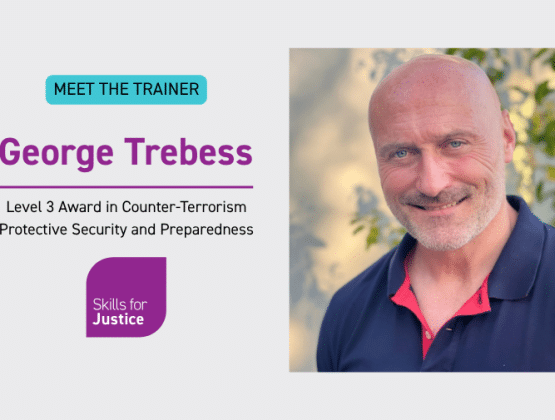
Book onto the Level 3 Award in Counter-Terrorism Protective Security and Preparedness qualification with Skills...
22.04.26
How organisations move from awareness to action in counter-terrorism protective security, with practical insights from...
16.04.26
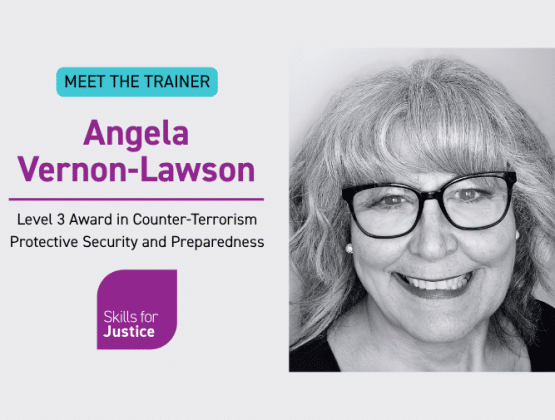
Angela Vernon-Lawson shares how organisations can build a culture of vigilance, empowering people - not...