Published by Skills for Justice

Published by Skills for Justice
Date 22.04.26

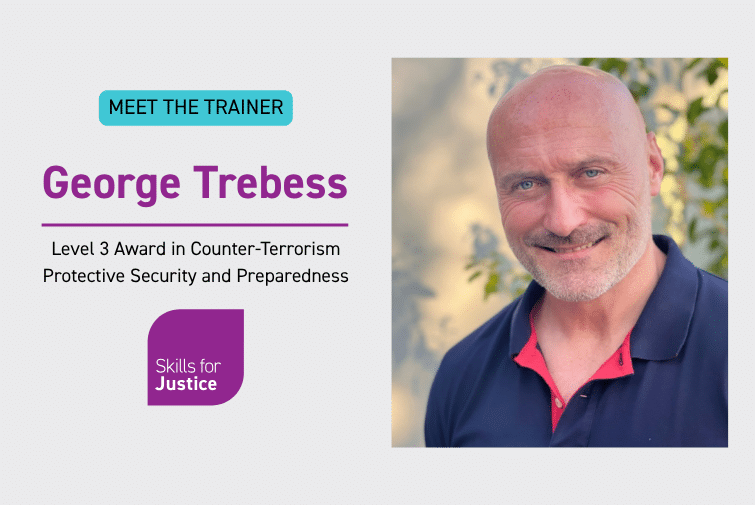
Organisations today face an increasingly complex threat landscape, but one of the biggest challenges isn’t understanding the risk. It’s knowing how to apply protective security principles in a way that works in practice.
We spoke to George Trebess, one of our expert trainers delivering the Level 3 Award in Counter-Terrorism Protective Security and Preparedness (CTPSaP), about how organisations can move from awareness to action and build practical, effective security capability.
Terrorist incidents in the UK are relatively infrequent, but their impact is immediate, significant, and far-reaching.
When incidents do occur, it’s often the people on the ground – staff, security, and even members of the public – who make the difference in those early moments.
Building capability isn’t about turning people into specialists. It’s about making sure they understand what to look for, feel confident to act, and know how to respond appropriately.
The Level 3 Award in Counter-Terrorism Protective Security and Preparedness (CTPSaP) gives learners a clear foundation. It helps them understand how attacks happen, how to think about risk, and what they can do within their role.
In simple terms, it helps organisations move from awareness to action.
In most organisations, the challenge isn’t understanding security; it’s applying it in a way that works in real environments.
Guidance can often feel too generic, or processes can be either too complex or too simplistic. As a result, staff aren’t always clear on what “good” looks like in their setting. And that’s where things can drift into paper-based compliance.
The key is to keep it practical – focus on the specific environment, use simple risk thinking, and build awareness into everyday routines.
A common misconception is that protective security is mainly about physical measures – barriers, access control, or technology. Those measures are important, but they’re only part of the picture.
In reality, many incidents have exposed gaps in awareness, behaviour, and communication rather than purely physical weaknesses.
People are often the strongest control – staff who understand what “normal” looks like, recognise suspicious behaviour, and feel confident to act or report can significantly reduce risk.
Another misconception is that security sits with one team. In practice, effective protective security is organisation wide.
Looking ahead, attacks are becoming simpler and sometimes harder to detect. So the priority should be getting the basics right:
Regular exercises are essential – plans need to be familiar, not just written down.
The organisations that are most effective are those that keep things simple, practical, and well-rehearsed.
National guidance can sometimes feel complex, but it doesn’t need to be. The key is to break it down into something people can apply in their own environment. That might include:
The focus should always be on what is proportionate and realistic. If people understand it and can apply it, it works. If they can’t, it won’t matter how well it’s written.
It’s important that people understand the limits of their role. They’re not expected to be experts in everything – and trying to be can actually create risk.
Good practice is recognising when something doesn’t feel right, using simple tools to assess it, and escalating early.
Seeking specialist support should always be seen as a positive step. Knowing when to ask for help is part of being competent, not a weakness.
If your organisation is looking to strengthen its approach to counter-terrorism, protective security and preparedness, explore the Level 3 Award in Counter-Terrorism Protective Security and Preparedness (CTPSaP) and discover how Skills for Justice Training can support your teams.
Counter-Terrorism Protective Security and Preparedness (CTPSaP) is a nationally recognised qualification designed to provide learners with the knowledge, skills, and understanding of terrorist attack methodologies, how to assess the likelihood of such threats, and the mitigation strategies available to reduce risk.
Following the introduction of the Terrorism (Protection of Premises) Act 2025 (also known as Martyn’s Law), protective security has become an increasingly important professional standard, while organisational preparedness has become a key responsibility.
Developed by SFJ Awards in partnership with the National Counter-Terrorism Security Office (NaCTSO), CTPSaP is the only qualification endorsed by Counter-Terrorism Policing.
CTPSaP is available through different qualification levels depending on where you are based in the UK: the SFJ Awards Level 3 Award applies in England, Wales and Northern Ireland, while the SFJ Awards SCQF Level 7 Award applies in Scotland.
CTPSaP is the acronym for the SFJ Awards qualification in Counter-Terrorism Protective Security and Preparedness.
The Terrorism (Protection of Premises) Act 2025, also known as Martyn’s Law, received Royal Assent on 3 April 2025.
It introduced new legal duties for certain premises and events across the UK to improve security and preparedness against terrorism.
Martyn’s Law is the common name for the Terrorism (Protection of Premises) Act 2025, which requires certain public venues and events in the UK to take proportionate steps to improve security and preparedness for potential terrorist attacks.
The Terrorism (Protection of Premises) Act 2025 (also known as Martyn’s Law) applies to publicly accessible premises and events in the UK where 200 or more people may be present. It places legal duties on those responsible for these locations – individuals, organisations and companies – with requirements that increase according to venue size and level of risk.
There are two tiers:
Standard Tier (200-799 people) – Publicly accessible premises such as retail, restaurants, entertainment venues, museums, galleries, and places of worship etc.
Enhanced Tier (800+ people) – Larger venues and events in high-capacity crowds.
No qualification or training on its own will make a venue, site or organisation compliant.
Compliance is about more than this. However, this qualification provides an excellent foundation of knowledge from which organisations can develop a counter-terrorism risk assessment and preparedness plan as outlined in the requirements of Martyn’s Law.
Skills for Justice Training is an approved training provider for the SFJ Awards Counter-Terrorism Protective Security and Preparedness (CTPSaP) qualification.
We deliver CTPSaP training through scheduled open cohorts across the UK, as well as dedicated organisational delivery for employers who want to train a group of learners at their own location.
The qualification available depends on where you are based:
• England, Wales and Northern Ireland: SFJ Awards Level 3 Award in Counter-Terrorism Protective Security and Preparedness
• Scotland: SFJ Awards Level 7 (SCQF) Award in Counter-Terrorism Protective Security and Preparedness
You can book onto an upcoming open cohort or contact us to discuss dedicated organisational delivery for your team.
As of 30 April 2026, the UK National Threat Level was raised to SEVERE. This means a terrorist attack is highly likely.
When the threat level is SEVERE, organisations should move to a heightened state of security, review contingency plans and ensure staff vigilance.
Find out more about how to review your security plans in response to the increased national threat level.
Yes, it is highly recommended and, in many cases, mandatory that organisations in the UK undertake counter-terrorism training, especially with the introduction of new legislation like the Terrorism (Protection of Premises) Act 2025 (also known as Martyn’s Law).
For more advice and guidance on counter-terrorism training, please visit Protect UK.
The Section 27 guidance for the Terrorism (Protection of Premises) Act 2025 (Martyn’s Law) was published in April 2026. It provides mandatory, actionable advice to help duty holders understand and comply with their legal obligations relating to security and public safety at qualifying premises and events.
For most places of worship, the government has stated that the requirements are not intended to be onerous or require significant physical investment.
A key consideration is whether it is reasonable to expect that 200 or more individuals may be present at the same time, even if only occasionally. Where this threshold is met, the premises is likely to fall within the scope of the Standard Tier under Martyn’s Law.
CTPSaP training is delivered across the UK, with the qualification aligned to the relevant national qualifications framework:
• England, Wales and Northern Ireland: SFJ Awards Level 3 Award in Counter-Terrorism Protective Security and Preparedness
• Scotland: SFJ Awards Level 7 (SCQF) Award in Counter-Terrorism Protective Security and Preparedness
Both qualifications are designed to develop knowledge and practical capability in counter-terrorism protective security and preparedness.

23.04.26
Organisations preparing for the Terrorism (Protection of Premises) Act 2025 must shift from awareness to...
16.04.26
Angela Vernon-Lawson shares how organisations can build a culture of vigilance, empowering people - not...

30.03.26
Book onto the Level 3 Award in Counter-Terrorism Protective Security and Preparedness qualification with Skills...

26.03.25
Martyn’s Law – formally The Terrorism (Protection of Premises) Bill – is a bill currently...

17.06.25
Martyn’s Law improves venue security, fosters collaboration with emergency services, and aligns with JESIP to...

10.07.25
We explore what the impact of Martyn's Law are for courts and how courts can...