Published by Skills for Justice

Published by Skills for Justice
Date 13.05.26

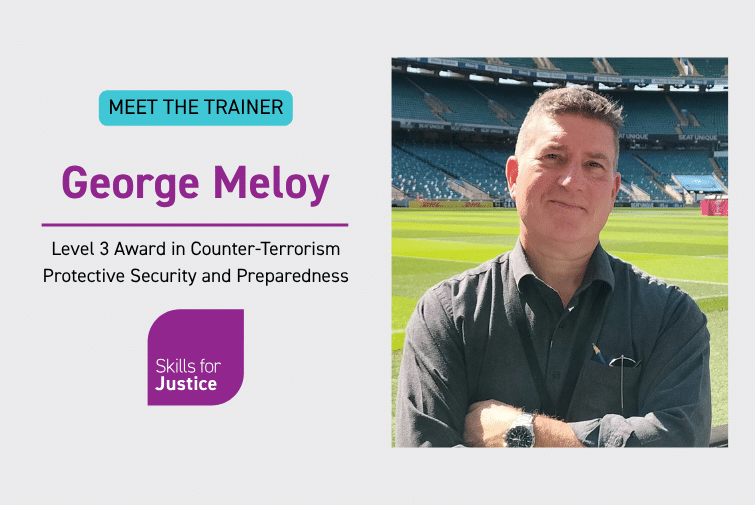
Protective security and preparedness are no longer issues for security teams alone. As threats continue to evolve – from terrorism and hostile attacks to emerging cyber and operational risks – organisations must ensure staff at every level are prepared to recognise, respond to, and manage uncertainty.
We spoke to George Meloy, one of our expert trainers delivering the Level 3 Award in Counter-Terrorism Protective Security and Preparedness (CTPSaP), about why preparedness matters, the importance of contingency planning, and what organisations can learn from planning major national events.
The risk from terrorism is constantly evolving – from changing attack methodologies and target selection to the capabilities of hostile actors.
Incidents such as the Manchester Arena attack highlight the risks posed by inadequate preparedness and a mindset where staff assume “someone else will deal with that”.
Organisations should instead foster a culture where all staff – from frontline personnel to senior leadership – feel confident to question unusual situations and challenge activity that doesn’t feel right.
Organisations that consider the risk of terrorism, embed effective security systems, and prepare for disruption are often better equipped to respond not only to terrorism-related incidents, but also to wider operational, financial, and commercial threats.
The Level 3 Award in Counter-Terrorism Protective Security and Preparedness (CTPSaP) provides a strong foundation for organisations by developing awareness of attack methodologies, how attacks are prepared, what to look out for, and the importance of building the right organisational mindset.
In my experience providing protective security advice for major events, one of the greatest risks is often the unpredictable.
While organisations can implement mitigations for known threats – such as entry searches or hostile vehicle mitigation measures – it is often unexpected incidents that place the greatest pressure on security operations. I always advise organisers of major multi-day events that, at some point, something unforeseen is likely to threaten to seriously compromise event security.
The ability to respond quickly and effectively is what makes the difference between a safe event and one where the safety of attendees or VIPs could be compromised.
For that reason, I strongly advocate the importance of contingency planning and encourage organisers to think carefully about how they would respond if things go wrong – particularly in relation to decision-making processes and escalation routes.
Preparation is critical. Effective decision-making relies on:
This becomes even more important during large-scale or high-profile events involving multiple agencies, locations, and operational teams.
Individuals responsible for different aspects of security – from hotels and venues, to secure transport movements and the personal protection of key attendees – must have a clear understanding of both the scope and limitations of their decision-making authority, without being hindered by unnecessary bureaucracy.
Ineffective decision-making often occurs where people do not fully understand their role, leading either to disproportionate responses – or, in some cases, no action being taken at all.
No protective security professional can be an expert in every area.
Threats, attack methodologies, and technologies continue to evolve rapidly, influenced by developments in global conflict, cyber threats, and emerging technologies such as drones.
Because of this, seeking specialist support should be viewed as a normal and necessary part of effective protective security planning. When reviewing the security arrangements for a major event or organisation, I would reasonably expect any security professional to seek specialist support in one or more areas.
Understanding the limits of a role – and knowing when to escalate or seek expert advice – is an important part of effective preparedness.
I’d encourage organisations to consider four key areas:
1. How do you respond to emerging threats?
Prepared organisations have clear frameworks for managing evolving threats and crises, rather than relying on ad hoc responses.
2. What is the culture of preparedness within your organisation?
Preparedness should be embedded into everyday operations – from staff training and awareness through to physical security checks and cyber hygiene.
3. How do you identify emerging threats?
Organisations should know how to access relevant intelligence, guidance, and trusted security information, and ensure it is effectively shared internally.
4. How do you learn from experience?
Prepared organisations regularly review what worked well, what didn’t, and how risks continue to evolve over time.
One of the biggest lessons I have learned is that organisations must plan not only for expected risks, but also for disruption that cannot always be predicted.
You need to plan for the unexpected, identify your contingencies, and make sure they are properly considered and resourced – you might not need them, but you never know…
I recall one major government summit hosted in a remote location. Once the event had concluded, the protected convoy transporting the host departed for the local airport via the only major route out of the area, while those responsible for security began reflecting on what had been a successful operation.
However, just 20 minutes from the airport, an entirely unrelated road traffic collision involving a tractor transporting hay bales, a caravan fire, and exploding gas canisters blocked the route completely.
The convoy was forced to divert immediately through narrow country lanes, demonstrating just how quickly operational plans can change – and why effective contingency planning is essential.
If your organisation is looking to strengthen its approach to counter-terrorism, protective security, and preparedness, explore the Level 3 Award in Counter-Terrorism Protective Security and Preparedness (CTPSaP) and discover how Skills for Justice Training can support your teams.
Counter-Terrorism Protective Security and Preparedness (CTPSaP) is a nationally recognised qualification designed to provide learners with the knowledge, skills, and understanding of terrorist attack methodologies, how to assess the likelihood of such threats, and the mitigation strategies available to reduce risk.
Following the introduction of the Terrorism (Protection of Premises) Act 2025 (also known as Martyn’s Law), protective security has become an increasingly important professional standard, while organisational preparedness has become a key responsibility.
Developed by SFJ Awards in partnership with the National Counter-Terrorism Security Office (NaCTSO), CTPSaP is the only qualification endorsed by Counter-Terrorism Policing.
CTPSaP is available through different qualification levels depending on where you are based in the UK: the SFJ Awards Level 3 Award applies in England, Wales and Northern Ireland, while the SFJ Awards SCQF Level 7 Award applies in Scotland.
CTPSaP is the acronym for the SFJ Awards qualification in Counter-Terrorism Protective Security and Preparedness.
The Terrorism (Protection of Premises) Act 2025, also known as Martyn’s Law, received Royal Assent on 3 April 2025.
It introduced new legal duties for certain premises and events across the UK to improve security and preparedness against terrorism.
Martyn’s Law is the common name for the Terrorism (Protection of Premises) Act 2025, which requires certain public venues and events in the UK to take proportionate steps to improve security and preparedness for potential terrorist attacks.
The Terrorism (Protection of Premises) Act 2025 (also known as Martyn’s Law) applies to publicly accessible premises and events in the UK where 200 or more people may be present. It places legal duties on those responsible for these locations – individuals, organisations and companies – with requirements that increase according to venue size and level of risk.
There are two tiers:
Standard Tier (200-799 people) – Publicly accessible premises such as retail, restaurants, entertainment venues, museums, galleries, and places of worship etc.
Enhanced Tier (800+ people) – Larger venues and events in high-capacity crowds.
No qualification or training on its own will make a venue, site or organisation compliant.
Compliance is about more than this. However, this qualification provides an excellent foundation of knowledge from which organisations can develop a counter-terrorism risk assessment and preparedness plan as outlined in the requirements of Martyn’s Law.
Skills for Justice Training is an approved training provider for the SFJ Awards Counter-Terrorism Protective Security and Preparedness (CTPSaP) qualification.
We deliver CTPSaP training through scheduled open cohorts across the UK, as well as dedicated organisational delivery for employers who want to train a group of learners at their own location.
The qualification available depends on where you are based:
• England, Wales and Northern Ireland: SFJ Awards Level 3 Award in Counter-Terrorism Protective Security and Preparedness
• Scotland: SFJ Awards Level 7 (SCQF) Award in Counter-Terrorism Protective Security and Preparedness
You can book onto an upcoming open cohort or contact us to discuss dedicated organisational delivery for your team.
As of 30 April 2026, the UK National Threat Level was raised to SEVERE. This means a terrorist attack is highly likely.
When the threat level is SEVERE, organisations should move to a heightened state of security, review contingency plans and ensure staff vigilance.
Find out more about how to review your security plans in response to the increased national threat level.
Yes, it is highly recommended and, in many cases, mandatory that organisations in the UK undertake counter-terrorism training, especially with the introduction of new legislation like the Terrorism (Protection of Premises) Act 2025 (also known as Martyn’s Law).
For more advice and guidance on counter-terrorism training, please visit Protect UK.
The Section 27 guidance for the Terrorism (Protection of Premises) Act 2025 (Martyn’s Law) was published in April 2026. It provides mandatory, actionable advice to help duty holders understand and comply with their legal obligations relating to security and public safety at qualifying premises and events.
For most places of worship, the government has stated that the requirements are not intended to be onerous or require significant physical investment.
A key consideration is whether it is reasonable to expect that 200 or more individuals may be present at the same time, even if only occasionally. Where this threshold is met, the premises is likely to fall within the scope of the Standard Tier under Martyn’s Law.
CTPSaP training is delivered across the UK, with the qualification aligned to the relevant national qualifications framework:
• England, Wales and Northern Ireland: SFJ Awards Level 3 Award in Counter-Terrorism Protective Security and Preparedness
• Scotland: SFJ Awards Level 7 (SCQF) Award in Counter-Terrorism Protective Security and Preparedness
Both qualifications are designed to develop knowledge and practical capability in counter-terrorism protective security and preparedness.

30.03.26
Book onto the Level 3 Award in Counter-Terrorism Protective Security and Preparedness qualification with Skills...
22.04.26
How organisations move from awareness to action in counter-terrorism protective security, with practical insights from...

23.04.26
Organisations preparing for the Terrorism (Protection of Premises) Act 2025 must shift from awareness to...
16.04.26
Angela Vernon-Lawson shares how organisations can build a culture of vigilance, empowering people - not...

26.03.25
Martyn’s Law – formally The Terrorism (Protection of Premises) Bill – is a bill currently...

10.07.25
We explore what the impact of Martyn's Law are for courts and how courts can...

17.06.25
Martyn’s Law improves venue security, fosters collaboration with emergency services, and aligns with JESIP to...